

For a San Francisco SaaS company, an Astro website will almost always load faster, pass Core Web Vitals, and rank better than a website built inside GoHighLevel — but that does not mean GoHighLevel is the wrong tool. GoHighLevel is an outstanding CRM, funnel, and automation engine. It is just not built to be a fast, SEO-first marketing site for a software company competing in the most crowded startup market in the world. The winning move for most SaaS operators is to run a static Astro site as the front door and keep GoHighLevel doing what it does best behind it.
This is the honest, operator-level comparison: what each platform actually is, how they score on the metrics that decide revenue (page speed, Core Web Vitals, SEO/AEO), why that matters more in the Bay Area than almost anywhere else, and the exact hybrid setup we deploy for SaaS teams.
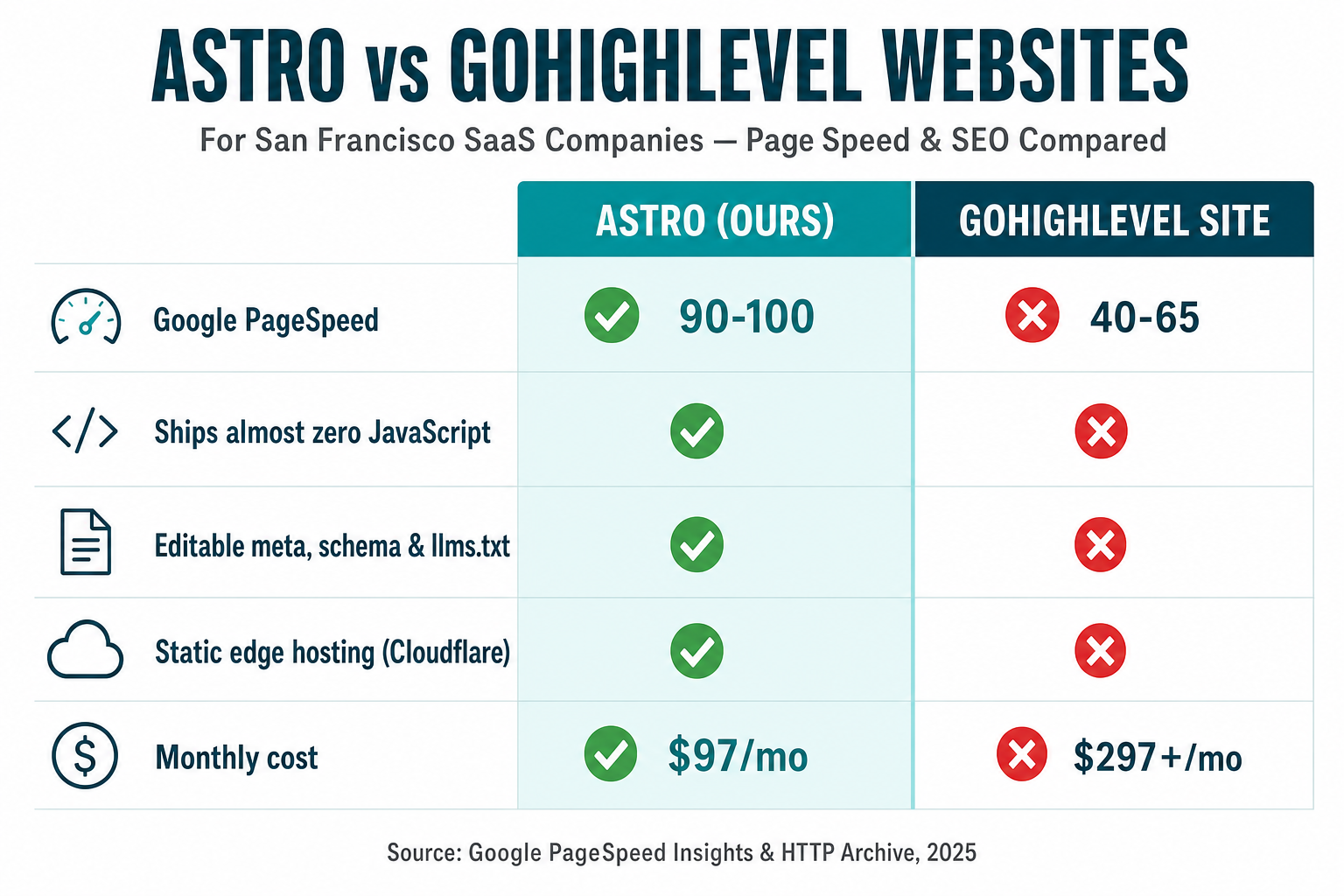
Table of contents
- The short answer
- Why website speed decides revenue for SaaS
- What a GoHighLevel website actually is
- What an Astro website is (and why it’s fast)
- Astro vs GoHighLevel: the head-to-head
- Core Web Vitals and SEO: who wins
- Why this matters more in San Francisco
- When a GoHighLevel website is the right call
- The setup we actually recommend
- Frequently asked questions
- Sources
- About the author
The short answer
If your website’s job is to convert expensive San Francisco traffic into free trials and demos, build it on Astro and connect it to GoHighLevel for CRM, pipelines, and automation. If your website’s job is a quick internal funnel, an event page, or a client microsite you’ll throw away in a quarter, GoHighLevel’s builder is fine — it’s fast to stand up and it’s already in your stack.
The reason comes down to architecture. A GoHighLevel site is a hosted page-builder: it renders through a heavy client-side application and loads third-party scripts, embeds, and tracking before your value proposition appears. An Astro site ships almost zero JavaScript by default and serves static HTML from a global edge network. On the metrics Google and your buyers actually measure, that gap is not subtle.
Why website speed decides revenue for SaaS
Speed is not a vanity metric. It is the first conversion step, and the data is unusually consistent across a decade of studies.
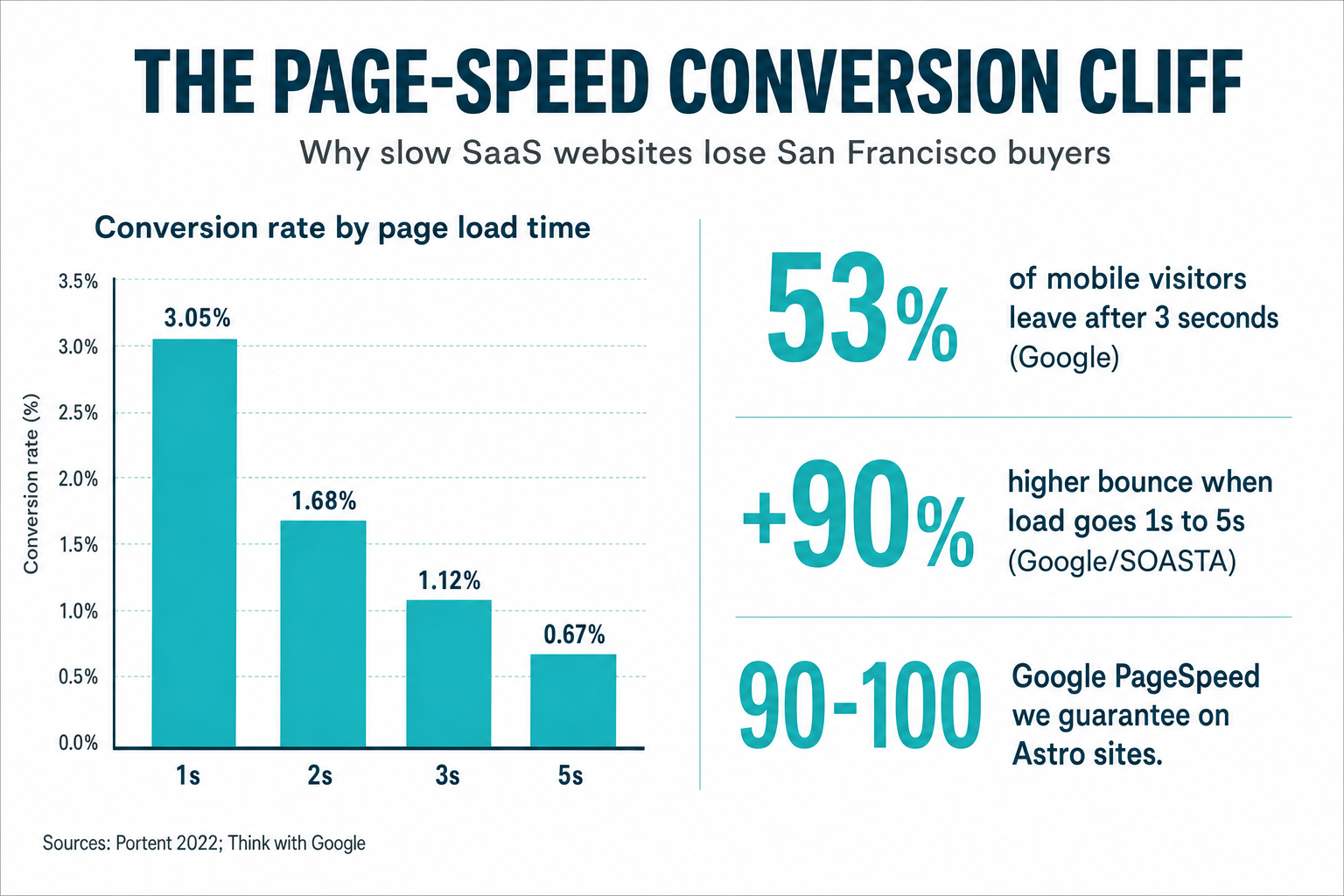
Google’s own mobile benchmark research, based on more than 900,000 landing pages, found that as page load time goes from 1 second to 3 seconds, the probability of a bounce increases 32% — and from 1 second to 5 seconds it jumps 90% (Think with Google, 2017). Separately, Google has reported that 53% of mobile visitors abandon a site that takes longer than three seconds to load (Google, via Marketing Dive).
Portent’s analysis of over 100 million pageviews put a number on the revenue impact: sites that load in 1 second convert at about 3.05%, dropping to 1.68% at 2 seconds, 1.12% at 3 seconds, and just 0.67% at 5 seconds (Portent, 2022). That is the difference between a healthy trial funnel and a leaky one — a website that loads in five seconds converts at barely a fifth of the rate of one that loads in one.
The compounding effect matters even more for SaaS. Retail speed research from Deloitte’s Milliseconds Make Millions study found that a 0.1-second improvement in mobile load time lifted retail conversion rates by 8.4% and average order value by 9.2% (Deloitte, via web.dev). Your CAC does not care whether the leak is at the ad, the landing page, or the trial form — every millisecond of front-door latency is money you already paid for and then lost.
What a GoHighLevel website actually is
Let’s be precise and fair, because we build inside GoHighLevel every day and resell it to SaaS clients.
GoHighLevel is a customer-acquisition platform: CRM, pipelines, calendars, email/SMS automation, forms, and a drag-and-drop funnel and website builder. That builder is genuinely useful. You can stand up a landing page in an afternoon, wire it directly to a pipeline, and start capturing leads without touching code.
But as a marketing website for a software company, it carries structural costs:
- It’s a client-rendered app. Pages load a large JavaScript bundle and third-party scripts before content paints, which is exactly what Core Web Vitals penalize.
- Meta, schema, and technical SEO are limited. Fine-grained control over titles, structured data (
JSON-LD), canonical tags, and anllms.txtfor AI answer engines ranges from clumsy to impossible. - Custom code and real design systems are constrained. You work within the builder’s guardrails; bespoke components and true performance tuning aren’t on the menu.
- Cost climbs with scale. A dedicated GHL plan for a client-facing site typically starts around $297/month, before add-ons.
None of that makes GoHighLevel bad. It makes it the wrong layer for the one page type where speed and SEO are the whole game.
What an Astro website is (and why it’s fast)
Astro is a modern web framework built on a simple idea: ship HTML, not JavaScript. Its “islands architecture” renders your pages to static HTML at build time and hydrates only the genuinely interactive pieces (a chat widget, a calculator), leaving the rest as fast, plain markup.
The result shows up in real-world field data. In Astro’s 2023 Web Framework Performance Report — built on Chrome UX Report and HTTP Archive data — Astro was the only JavaScript framework where more than half of tracked sites passed Google’s Core Web Vitals assessment, against an all-sites average of roughly 40.5% (Astro, 2023). More recent HTTP Archive analysis reported by Search Engine Journal put Astro’s pass rate around 65% versus roughly 40% for WordPress-class sites (Search Engine Journal, 2025).
That is the whole thesis of our Get a Website service: we build on Astro, serve from Cloudflare’s global edge, and guarantee a 90+ Google PageSpeed score (often a perfect 100) on both mobile and desktop.
Astro vs GoHighLevel: the head-to-head
Here is the comparison the way we walk SaaS founders through it. The GoHighLevel PageSpeed range is illustrative — GoHighLevel is not broken out in public performance datasets, so we base it on live PageSpeed Insights tests of GHL funnel pages, which land in the same heavy-JavaScript, page-builder class as WordPress sites.
| Plan | Astro Website (ours) recommended | GoHighLevel Website |
|---|---|---|
| Price | $497 one-time + $97/mo | ~$297/mo plan (+ add-ons) |
| Feature 1 | Google PageSpeed: 90-100 (guaranteed) | Google PageSpeed: typically 40-65 (illustrative) |
| Feature 2 | Ships almost zero JavaScript by default | Heavy client-side JavaScript bundle |
| Feature 3 | Static-first HTML from Cloudflare's global edge | Rendered by the hosted builder app |
| Feature 4 | Full control of meta, JSON-LD schema, canonical | Limited meta / schema / canonical control |
| Feature 5 | llms.txt + AEO/GEO built for AI answer engines | No native llms.txt; AEO/GEO is manual at best |
| Feature 6 | Custom code, components, and design systems | No custom code — builder guardrails only |
| Feature 7 | Passes Core Web Vitals out of the box | Core Web Vitals often fail on mobile |
| Feature 8 | Up to 60 pages incl. feature/use-case/location pages | Great for quick funnels and internal pages |
| Feature 9 | Connects to GoHighLevel CRM + AI chat widget | Native CRM, pipelines, and automation (its strength) |
| Feature 10 | Managed hosting, domain, SSL, and updates included | Website is one feature of a broader CRM platform |
| Get an Astro site | Keep GHL for CRM |
Core Web Vitals and SEO: who wins
Core Web Vitals — Largest Contentful Paint, Interaction to Next Paint, and Cumulative Layout Shift — are a confirmed input to Google’s ranking systems as part of the page experience signals (Google Search Central). They are not the only factor, but when two SaaS sites target the same keyword with comparable content, the faster, more stable one has a real edge.
And most of the web still fails. According to the HTTP Archive Web Almanac 2025, only about 48% of mobile sites and 56% of desktop sites had “good” Core Web Vitals (HTTP Archive, 2025). A big part of that is weight: the median web page in 2025 weighed roughly 2.56 MB on mobile and 2.86 MB on desktop (HTTP Archive, 2025). Page-builder platforms — GoHighLevel included — sit on the heavy end of that distribution. Astro sits at the light end by design.
There’s a second SEO front that page-builders lose by default: AI answer engines. Google AI Overviews, ChatGPT, and Perplexity increasingly intercept research queries, and they favor sites with clean, crawlable HTML, valid structured data, and an llms.txt manifest. On Astro we control all three; inside GoHighLevel you largely cannot. If you want the deeper playbook, we wrote it up in SaaS SEO in 2026: Rank, Get Cited, Convert Trials.
Why this matters more in San Francisco
San Francisco and the wider Bay Area are the single most competitive software market on earth. In 2024 the region captured roughly 57% of all US venture funding — about $90 billion of $178 billion (Crunchbase News, 2024). That concentration cuts both ways: enormous demand, and enormous competition for every high-intent search.
Two practical consequences for a San Francisco SaaS company:
- Traffic is expensive. When you’re bidding against hundreds of funded competitors for “workflow automation software” or a category term, a five-second landing page that converts at 0.67% is a budget bonfire. Front-door speed is CAC efficiency.
- Buyers are sophisticated and impatient. Your prospects are engineers, product leads, and operators who evaluate a dozen tools a month. A slow, janky marketing site is read as a signal about the product itself.
Ranking for local-intent and category queries — and getting cited in the AI answers Bay Area buyers now ask first — rewards the technical fundamentals Astro delivers and GoHighLevel’s builder can’t.
When a GoHighLevel website is the right call
We won’t pretend Astro wins every scenario. Use GoHighLevel’s builder when:
- You need a throwaway funnel fast — a webinar, a launch page, a limited campaign — and speed-to-publish beats page speed.
- The page is gated or internal — a client portal entry, an application form, an event RSVP — where SEO is irrelevant.
- You have no dev/agency support and one place to manage everything matters more than squeezing out ranking gains.
For those jobs, GoHighLevel is already in your stack and perfectly capable. If you want help wiring those funnels, forms, and pipelines correctly, that’s exactly what our GHL development team does.
The setup we actually recommend
The false choice is “Astro or GoHighLevel.” The right answer for most SaaS teams is both, in the right roles.
That’s precisely how we deliver Get a Website: an Astro build with a guaranteed 90+ PageSpeed, category SEO plus AEO/GEO, feature/use-case/location pages, an embedded AI chat widget, and a direct connection into your GoHighLevel CRM — for $497 one-time + $97/month (managed hosting, domain, SSL, and maintenance included). Add automatic blogging for $197/month total, or rebrand up to five sites for a $1,200 one-time fee. If your needs go beyond a marketing site into product surfaces or portals, our custom software team picks up from there.
Speed is the cheapest conversion-rate optimization you will ever buy — it’s a one-time build decision that pays out on every visit forever. For a San Francisco SaaS company fighting for expensive traffic, that’s not a nice-to-have.
Frequently asked questions
Is an Astro website really faster than a GoHighLevel site?
Yes, in almost every real-world case. Astro ships static HTML with almost no JavaScript and serves it from a global edge network, while a GoHighLevel site renders through a heavy client-side builder app. In field data, roughly 65% of Astro sites pass Google's Core Web Vitals versus about 40% for WordPress-class page-builder stacks that GoHighLevel sites resemble. We guarantee a 90+ Google PageSpeed on the Astro sites we build.
Do I have to leave GoHighLevel to get a fast website?
No — and you shouldn't. Keep GoHighLevel as your CRM, pipeline, and automation engine. Put a fast Astro site in front of it for your public marketing pages, and connect your forms and chat widget straight into GHL. You get the speed and SEO of Astro plus every automation you already built.
Does website speed actually affect Google rankings?
It's one confirmed input. Google's page experience signals include Core Web Vitals — Largest Contentful Paint, Interaction to Next Paint, and Cumulative Layout Shift. Speed alone won't outrank far better content, but between two comparable SaaS pages targeting the same keyword, the faster, more stable one has an edge — and it converts more of the traffic it earns.
Why does page speed matter more for a San Francisco SaaS company?
Because the Bay Area is the most competitive software market anywhere — it captured about 57% of all US venture funding in 2024. Traffic and keywords are expensive, and buyers are sophisticated. A slow site that converts at a fraction of the rate of a fast one wastes acquisition budget you already spent, and reads as a red flag about your product.
What does an Astro website from you cost, and what's included?
A single Astro site is $497 one-time plus $97/month, which covers managed Cloudflare hosting, your domain, SSL, and maintenance. You get up to 60 pages including feature, use-case, and location pages, full schema/AEO/GEO, an AI chat widget, and a connection to your GoHighLevel CRM. Automatic blogging is $197/month total, and up to five sites is a $1,200 one-time fee.
Is GoHighLevel's website builder ever the better choice?
For quick, disposable funnels, gated internal pages, or when speed-to-publish and single-tool simplicity matter more than SEO, GoHighLevel's builder is a fine fit — it's already in your stack. It's just the wrong layer for the marketing pages where page speed and search visibility decide revenue.
Sources
- Think with Google — Mobile Page Speed New Industry Benchmarks (2017)
- Google / Marketing Dive — 53% of mobile users abandon slow sites
- Portent — Site Speed Is (Still) Impacting Your Conversion Rate (2022)
- Deloitte — Milliseconds Make Millions (via web.dev)
- Astro — 2023 Web Framework Performance Report
- Search Engine Journal — Core Web Vitals: WordPress and Astro (2025)
- HTTP Archive Web Almanac 2025 — Performance
- HTTP Archive Web Almanac 2025 — Page Weight
- Google Search Central — Understanding Page Experience
- Crunchbase News — US venture funding concentration in the Bay Area (2024)
About the author
Devon Asante is a GHL Automation Architect based in Denver, CO. A former agency operator who resold GoHighLevel to software clients, he now designs snapshot systems and the fast front-end sites that feed them — pairing an Astro marketing layer with a GoHighLevel automation engine so SaaS founders ship on rails from day one. He writes about CRM plumbing, multi-channel messaging, and the unglamorous performance details that quietly compound MRR.
Related reading: SaaS SEO in 2026 · Product-Qualified Leads for SaaS · SaaS Lifecycle Marketing · Reduce SaaS Demo No-Shows